
Cutting across party lines, chief ministers and others leaders urged the people to follow the self-imposed curfew from 7 am to 9 pm, noting that "social distancing" was key to breaking the chain of infection, as the number of coronavirus cases rose to 283 after 60 new cases were detected on Saturday, the highest so far in a day, and states like Maharashtra, Odisha and Bihar imposed partial lockdown till month end.
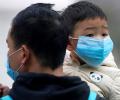
How China's all powerful Communist party bungled the response to the coronavirus crisis.
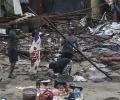
With water receding from most areas in Chennai and its suburbs, sanitation and conservancy workers face the mammoth task of removing one lakh tons of stinking garbage littering the streets as bright sunshine further eased the situation.

'Whenever you roll out: effectiveness is important, operational logistics are important, side effects are important and vaccine hesitancy is important.'

India is the fifth worst-hit nation by the COVID-19 pandemic after the United States, Brazil, Russia and the United Kingdom, according to data issued by the Johns Hopkins University.
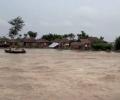
Floods have forced people to eat rats to survive as there is nothing left to eat. M I Khan reports from Patna.

'Why not simply make some more ventilators and find some more beds? How much would it cost?' asks Ambassador M K Bhadrakumar.

Emergency measures are needed to avoid "a total collapse in public security, health, education, transport and environmental management," a decree in the state's Official Gazette said.

'Should the Congress take Jyotiraditya's departure as good riddance?', asks Mohammad Sajjad.

'Prevention plus vaccination is what is going to take us into better territory by September or October.'

Here's a glimpse of all that happened around the world last week, in 10 images.
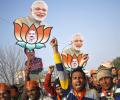
The emphatic victory in all three municipal corporations in Delhi will enthuse the party to keep its winning trajectory for the next polls, reports Sahil Makkar.

'Where children are told soothing bedtime tales, our daily fare were stories of the bloodshed my family had witnessed, scenes, my father said, of the sewers turning red and the overpowering stench of corpses,' remembers Sunil Sethi.

'Kota is good if you are good' and 'Kota can make you or break you' are two cryptic statements Kota students often offer to explain life in their world.

The year 2014 is coming to an end. It was the year of conflict, the year of strife. Year 2014 will be remembered for several reasons -- the rise and threat of the Islamic State, the downing of two Malayasia Airlines aircraft and the sudden and effective way of using hastags on social media to generate a buzz about the event. After all, who can forget #theicebucket challenge and the phenomenon it grew into. Read on as we bring you an overview of international news and events of 2014.

More than 100 medical experts, academia and scientists on Friday have called for the Rio Olympic Games to be postponed or moved because of fears that the event could speed up the spread of the Zika virus around the world. Their assessment counters the view of some leading experts of infectious disease who say that as long as the necessary precautions are taken there is no reason to cancel the Games. On Thursday, Dr. Tom Frieden, director of the U.S. Centers for Disease Control and Prevention, declared there was no public health reason to cancel or delay this summer's Games. In a public letter posted online, the group of 150 leading public health experts, many of them bioethicists, said the risk of infection from the Zika virus is too high. The letter was sent to Dr. Margaret Chan, director-general of the World Health Organization, and urged that the Games, due to be held in Rio de Janeiro in August, be moved to another location or delayed.

Grappling with the worst dengue outbreak in five years, the Delhi government on Wednesday issued a "blanket order" giving its hospitals powers to employ more doctors and nursing staff and directed private hospitals to increase bed capacity to deal with rising cases of the vector-borne disease.

'The majority of transmission will be via people who are within two metres of one another.' 'The closer you are, the more likely that you'll be infected.'

Chief Minister Jayalalithaa announces Rs 4 lakh compensation for the kin of dead.
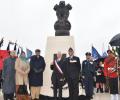
'The Indian Army served with honour and distinction in France and Flanders, East Africa, Gallipoli, Aden, Egypt, Mesopotamia, Palestine, Transcaspia, Persia and even China.' 'The sacrifice of India's soldiers was consigned to the dustbin of history in the post-colonial world.'

'...and the government is suppressing the truth.'

How did Mansoor Peerbhoy, an academically bright, suave and soft-spoken young man, who never exhibited any jihadist tendencies, go on to head the Indian Mujahideen's media cell?

Here's a glimpse at what happened around the world last week

Prime Minister Narendra Modi, who did not make it to the final eight selected by TIME for the annual 'Person of the Year' title, has been hailed as one by its readers in an online poll conducted by the publication. Let's take a look at the 10 names that forced Modi out of reckoning for the title.

Almost everyone in Gorakhpur has a story about an Adityanath intervention that helped push through a piece of work that would've been otherwise impossible.

'Lives are lost and the social fabric is torn. The progress of the nation comes to a grinding halt.'

'Pluralism is a fundamental fact of Indian life,' Colonel Anil A Athale (retd) tells members of the US Congress. 'Indians created a secular/plural State because that is what the majority believes in and not the other way round.'
.jpg)
Candidates in the current state elections must be made to offer specific promises against which their performance can be measured, says Indira Rajaraman

The ninth edition of the Global Peace Index, which ranks the nations of the world according to their level of peacefulness, has ranked Syria as the most dangerous country in the world.

Imagine being a part of a country, but being discriminated against by the majority community and atrocities being committed against you by the state. This is the deplorable conditions that the Rohingyas of Myanmar live in where they are cut off from their livelihoods and sources of income, unable to access markets, hospitals and schools, and have little or no access to relief aid. In order to understand the situation and the genesis of the tragedy unfolding, Rediff.com's Archana Masih speaks to Ambassador Vijay Nambiar, the United Nations' Chef de Cabinet (Chief of Staff), who had served a long stint with the UN in New York on the issue.

'He was believed to finish his own work in an hour and spend the remainder of the time walking from one office to another, sitting down with the harried junior staff and helping them sort out the problems they were working on.'
